Rethinking Integration: Why MuleSoft Agent Fabric Challenges the Status Quo

Rethinking Integration: Why MuleSoft Agent Fabric Challenges the Status Quo
For the better part of two decades, enterprise integration has run on a simple promise: define the rules up front, and the system will do exactly what you told it to do. That promise built entire careers around API-led connectivity — tidy layers, predictable data contracts, deterministic routing. It also built systems that are excellent at handling the case you planned for, and nearly useless the moment reality wanders off script. Agentic AI is now forcing a question onto every architecture review: what happens when "off script" becomes the norm rather than the exception?
What Is MuleSoft Agent Fabric, Exactly?
Strip away the branding and Agent Fabric is Salesforce's answer to a problem it calls agent sprawl: as teams adopt AI faster than they can govern it, agents pile up across teams, platforms, and vendors, each one blind to the others, with no shared visibility and no consistent rules. Salesforce describes it as working like an air traffic controller for AI — a control plane that lets agents built on completely different platforms discover each other, hand off work, and stay inside the same governance perimeter, instead of operating as disconnected, unmanaged silos.
Importantly, it isn't a replacement for MuleSoft's integration layer. It's a layer that sits on top of it, so autonomous agents can use your existing APIs as tools while everything they do stays auditable.
The Architecture We Built for a Predictable World
Traditional MuleSoft architecture is, frankly, a triumph of discipline. System APIs talk to backends, Process APIs apply business logic, and Experience APIs shape data for a specific channel. Everything is structured, versioned, and governed. It's the right answer for payment processing, inventory updates, and any workflow where the input/output schema is well-defined.
The catch is that this discipline comes from rigidity, not flexibility. Every decision the system can make was written into it by a developer, in advance. That's fantastic when the world matches your assumptions — and a liability the instant it doesn't.
When Reality Doesn't Match the Schema
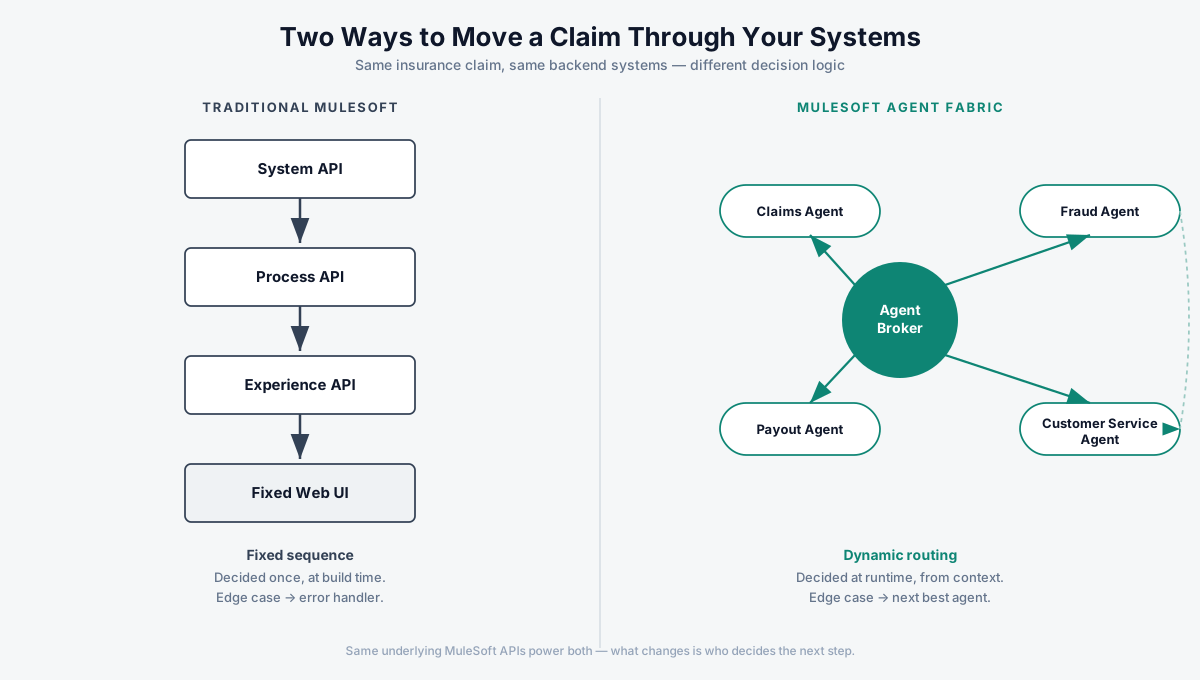
Picture an insurance company processing an auto accident claim. Under the hood, this requires pulling customer records, checking submitted documents for fraud, triggering customer communication, and routing for approval. Straightforward, as long as the claim looks like the claims your developers imagined.
Now picture the claim that doesn't: a description written in a mix of English and Spanish, attached to a blurry photo of a police report. A traditional, rule-based pipeline has exactly one move here — kick it to error handling, or drop it in a queue for a human to sort out. It's not that the system is broken. It's that unstructured, unpredictable input was never part of the design, so there's nothing for it to adapt to.
A Different Way to Think: One Control Plane, Four Pillars
This is the gap Agent Fabric is built to close — not by replacing the integration layer, but by adding an orchestration layer on top of it that can reason instead of just execute. It rests on four pillars:
- Discover — a shared agent registry catalogs agents, tools, and MCP servers so teams reuse what already exists instead of quietly rebuilding it in a silo.
- Orchestrate — an intelligent broker routes tasks to whichever agent is best suited, based on context — and increasingly, a blend of fixed rules and LLM judgment, so routing stays predictable without giving up flexibility entirely.
- Govern — enterprise guardrails apply spending limits, PII masking, and per-user authorization consistently across every agent-to-agent and agent-to-tool interaction.
- Observe — a visual map of how agents are interacting in real time, surfacing confidence scores, bottlenecks, and hallucination risk — not just a log of what happened.
The shift that matters isn't the tooling — it's the underlying assumption. Traditional architecture asks, "did this input match a pattern we coded for?" Agentic architecture asks, "what's the best next step, given everything we know right now?"
Same Claim, Very Different Outcome
Run that messy claim through an agent-based ecosystem instead, and the story changes:
- A Claims Agent reads the unstructured, mixed-language text, understands the context, and pulls policy details through existing APIs.
- The Agent Broker spots the attached police report and hands it to a Fraud Agent to check for signs of alteration.
- Once cleared, a Payout Agent executes payment through existing automation tools.
- If fraud is flagged, the broker routes to a Customer Service Agent that requests clearer documentation — without anyone having written a rule for "mixed-language claim with a blurry photo" in advance.
Nothing about the underlying APIs changed. What changed is that the system can now improvise around a case nobody explicitly coded for.
Traditional vs. Agentic, Side by Side
| Dimension | Traditional MuleSoft | Agent Fabric |
|---|---|---|
| Execution | Deterministic, step-by-step code | Autonomous — the AI decides the next best step |
| Data it handles well | Structured (JSON, XML, CSV) | Unstructured (emails, images, audio) |
| Routing | Static gateways and choice routers | Dynamic, context-aware orchestration |
| Governance | API policies — rate limits, OAuth | Agent guardrails — PII masking, LLM safety |
| Visibility | Log tracing | Visualized AI reasoning paths |
| Adaptation | Requires a code change | Adapts at runtime |
Neither side of this table replaces the other. Structured, high-compliance, "must-be-deterministic" workflows still belong in traditional MuleSoft. The point isn't to throw that discipline away — it's to stop pretending it's sufficient for everything.
Do You Actually Need Salesforce Einstein?
A question that comes up in nearly every one of these conversations: if you're going agentic, do you need to buy into a specific AI ecosystem like Salesforce Einstein? Short answer — no. You can call Claude, GPT, or Vertex AI directly. The trade-off is real, though: going direct means you own PII masking, RAG pipelines, and function-calling glue code yourself, in exchange for full flexibility and lower licensing cost. Einstein trades some of that flexibility for built-in data governance and native tool execution against Salesforce Flows and Apex.
The more interesting option is that you don't have to pick a side. A Bring Your Own LLM model lets you plug your own OpenAI, Vertex, or Azure key into Salesforce's governance layer — you keep model choice, and the platform still enforces trust and grounding rules on the data before the model ever sees it.
The real dividing line isn't which vendor you pick. It's whether your architecture separates static data governance — enforced once, at the API layer — from the dynamic runtime guardrails an autonomous agent needs when its next move genuinely can't be predicted in advance.
The Architecture That Adapts: Let the Plumbing Stay Boring
The recommended shape for this is refreshingly simple, and that simplicity is the point:
- Internal users (Claude, Copilot) and external cloud agents both talk to a single MuleSoft API Gateway layer, handling OAuth, PII masking via DataWeave, rate limiting, and centralized auditing.
- That gateway is the only path to the enterprise backends — Salesforce, SAP, databases.
The value of this shape is that it cleanly separates two very different jobs:
- MuleSoft secures the plumbing — data access, authentication, compliance, one source of truth.
- The AI platform secures the brain — reducing hallucinations, catching prompt injection, stopping jailbreak attempts.
Because every AI tool has to route through the same gateway, you get one place to audit, one place to rate-limit runaway agents, and one place to swap an LLM without touching a single integration. That last part is the quiet superpower here: the AI landscape is moving fast enough that "locked in" is now a genuine architectural risk, not just a procurement inconvenience.
Smart Model Routing: Cutting AI Costs Without Cutting Corners
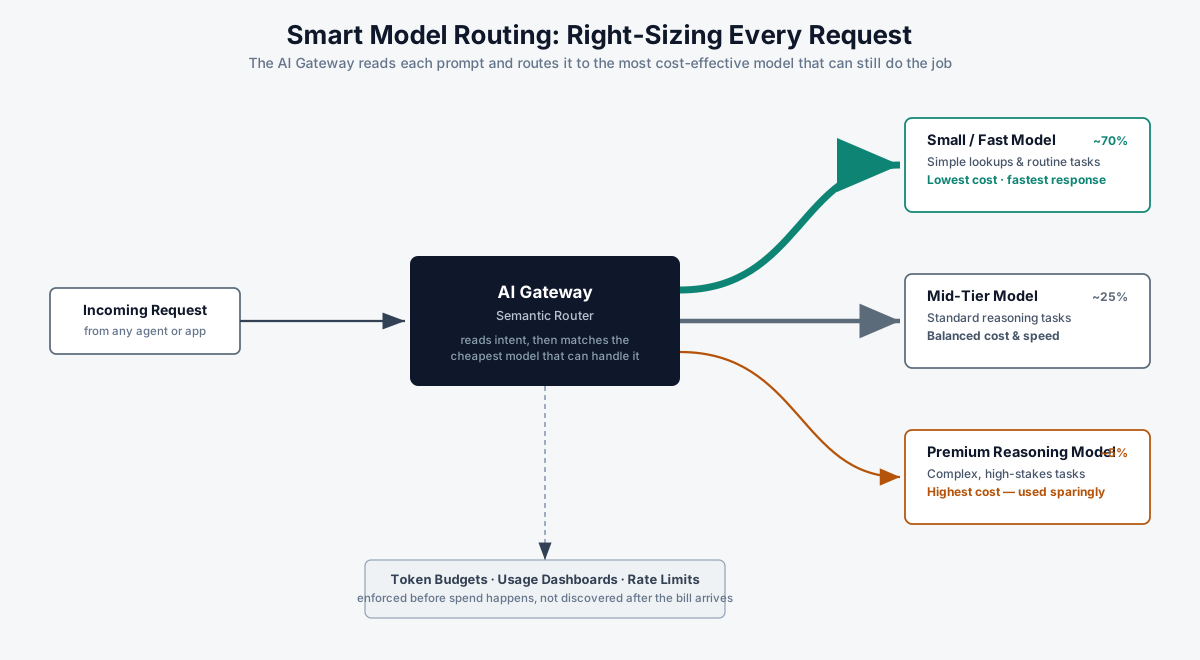
Here's a detail that's easy to miss and expensive to ignore: without routing logic in place, every request defaults to the most expensive model available, whether the task needs it or not. A one-line status lookup and a multi-step fraud investigation end up costing the same, simply because nothing in the stack knows the difference.
The fix, increasingly built into the gateway layer sitting in front of your agents, is semantic routing: the gateway reads what a prompt is actually asking for and sends it to the cheapest model that can still get it right — simple lookups and FAQs to a small, fast model; standard reasoning to a mid-tier model; and complex, high-stakes judgment calls to a premium model, reserved for the requests that genuinely need it.
This does three things for cost and speed at once:
- Token optimization — usage is tracked by application and business group, at daily and monthly granularity, so spend is visible before the invoice lands rather than after.
- Speed — routine requests never wait in line behind a large, slow model; they get answered by whichever model is fast enough for the job.
- Provider flexibility — a single logical endpoint sits in front of every provider, with automatic fallback if one goes down, so swapping or adding a model doesn't mean rewriting the application that calls it.
Budgets and rate limits get enforced at the gateway itself, before the overage happens — not discovered three weeks later in a finance review.
Rethinking the UI: From Fixed Screens to Agent-Composed Interfaces
There's a quieter shift happening alongside all of this, and it challenges an assumption most of us never thought to question: that a screen is something a developer designs once, and every user sees the same version of it.
Generative UI flips that. Instead of an agent replying with a wall of text, or a developer hand-building a dashboard for every possible use case in advance, the agent generates — or selects — the interface itself, at runtime, based on who's asking and what they actually need to see. An analyst querying the same claims data might get a chart with filters. A manager gets a single approve-or-flag decision. A customer gets a plain-language explanation with an upload button. Same underlying agent, same underlying MuleSoft APIs — three completely different interfaces, none of them hard-coded in advance.
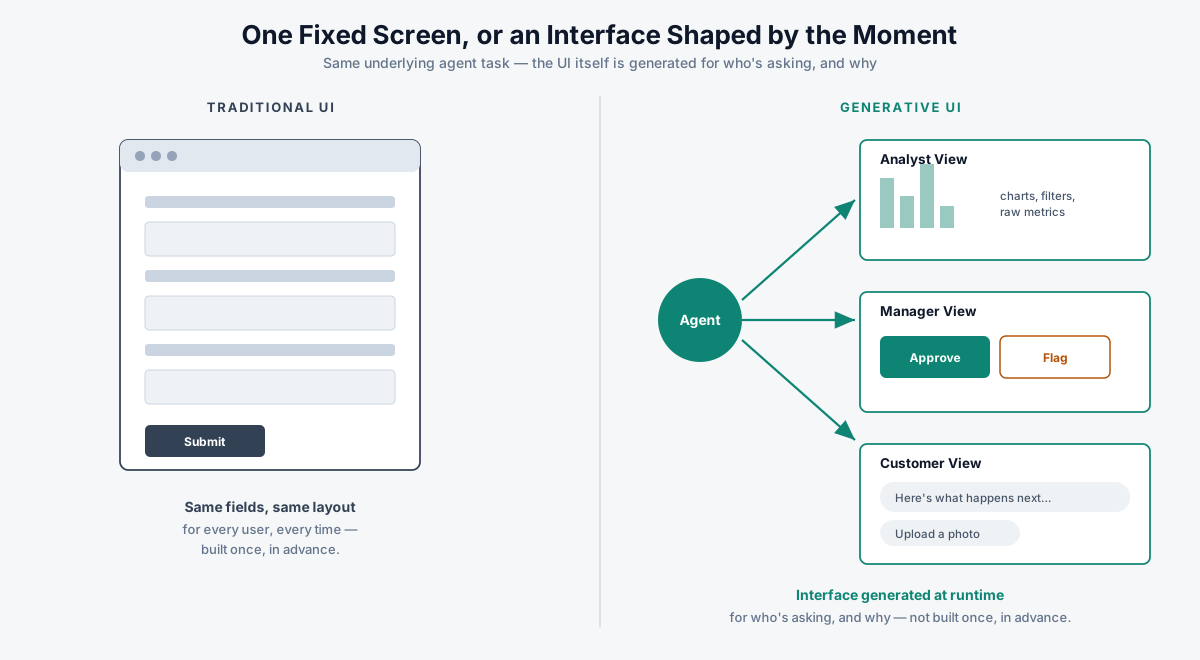
This is being standardized fast, through emerging protocols like MCP-UI, A2UI, and AG-UI, which give an agent a structured way to describe what interface a moment calls for, so the application can render it consistently rather than improvising raw HTML on the fly. For an integration architecture, the implication is direct: your APIs stop being consumed by one fixed frontend and start being composed, differently, every time a different agent or user calls on them.
It's the same underlying principle as everything else in this piece — stop assuming the thing you built once is still the right shape for every situation that follows.
Why This Is a Status-Quo Problem, Not Just a Technology Problem
It's tempting to treat all of this as a tooling decision — pick a broker, wire up some agents, done. The harder, more valuable shift is mental. Deterministic architecture optimizes for a world that holds still long enough for you to document it. That world is getting smaller. Customer inputs are messier, expectations move faster, and the cost of "we'll fix it in the next sprint" keeps climbing.
Challenging the status quo here doesn't mean discarding twenty years of hard-won integration discipline. It means refusing to accept "we'd need a code change for that" as a permanent answer — whether that's a claim your routing logic can't handle, a model bill nobody's watching, or a UI that was designed for one user and now serves ten different ones badly. The fix in each case is the same shape: keep the boring, compliance-critical parts rock solid, and let the reasoning, routing, and presentation layers stay free to adapt. That combination — stable plumbing, adaptable brain — is what lets an organization absorb change quickly instead of scheduling it for next quarter.
Getting Started
You don't need to boil the ocean to test this:
- Audit your existing APIs and document them properly in OpenAPI/Swagger — agents can't use tools they can't understand.
- Map your use cases — separate the workflows that genuinely need dynamic decision-making from the ones that are fine exactly as they are.
- Pick one cloud platform for agent hosting rather than trying to support all of them on day one.
- Define scoping rules in DataWeave so each agent only ever sees the data it needs.
- Audit your current LLM spend — you likely can't say today which team's agent is calling which model, or why. That's the first gap intelligent routing closes.
- Prototype small — one internal workflow, like triaging support tickets, before anything customer-facing.
The Bottom Line
The organizations that get the most out of agentic AI won't be the ones with the flashiest agents — they'll be the ones whose underlying architecture was already flexible enough to let those agents plug in safely. Traditional, deterministic MuleSoft isn't the enemy here; treating it as the whole answer is. The status quo was built for a world that mostly matched the schema. It's worth building the next layer for the world that doesn't.
Stay tuned for more on where agentic architecture is heading.
Summary
Why rigid, rule-based integration can't keep up with modern business — and how MuleSoft Agent Fabric points toward a more adaptable architecture.