My AI Assistant Micro-Trades While I Work: +$42.49 in 4 Weeks
My AI Assistant Micro-Trades While I Work: +$42.49 in 4 Weeks
What if making a few extra dollars a day didn't mean a second job, a side hustle, or staring at charts all day?
What if it meant one small trade a day, planned before the market even opens, with rules so strict that the plan makes the decisions — not your emotions?
That is the experiment I started on September 24, 2026. The goal sounds almost too small: make $5 to $10 a day. Start at $1 a day. Prove the system works. Then scale.
Four weeks in, here is the honest scoreboard: 11 trades. 10 wins. 1 loss. +$42.49.
And here is the twist: I run every trade on margin — no new cash deposited, just a loan against holdings I already have, so losses and interest still come out of my account.
The Team: Me, Two Stocks, and an AI Named Malli
Every good experiment needs a small, focused team.
- Two stocks only: Dollarama (DOL.TO) and Enbridge (ENB.TO). Two steady Canadian companies I understand. No meme stocks. No crypto roller coasters.
- One trader: me. I place every order myself, in my own brokerage account.
- One analyst, coach, and scorekeeper: Malli, my AI assistant in the Muse app.
For this experiment, Malli has three jobs:
- Before the market opens: send me a ready-to-execute trading plan.
- After the market closes: check what actually happened and keep me honest.
- Always: track every single trade in a small tracker app built in Muse.
I never asked Malli to "pick winning stocks." I asked it to run a system. That difference is the whole story.
The Rules of the Game
Boring rules. Zero drama. Written down before the first trade:
- Maximum $1,000 per trade. Small bets only.
- One position at a time.
- In and out the same day. Nothing sleeps overnight (one early trade held a few days on margin — more on that below — and it taught me why this rule exists).
- Take profit at +0.5% to +1%. Small, repeatable wins.
- Stop loss at −1%. If the price hits the stop, sell immediately. No hoping. No "it might come back."
- Never move the stop. Never average down.
- Log every trade — especially the red ones.
The magic number here is the stop. A −1% stop on a $1,000 trade means the worst day costs about $10. The experiment can survive a bad week. That's the point.
What a Morning Looks Like: The 6 AM Ticket
At 6:00 AM Pacific, before the TSX opens, Malli sends me an order ticket — not a vague opinion, but exact numbers computed from the last five days of price action. Here is a real one, from Tuesday, October 20:
ENB.TO — prior close $66.59
- BUY LIMIT: $66.60 (15 shares ≈ $999)
- SELL LIMIT (take profit): $66.93 (+0.5%)
- STOP: $65.93 (−1%) — if touched, sell at market immediately, log it red, day is done
- Stretch target: $67.27 (+1.0%) — optional, only if momentum is strong
- If it opens below the entry zone: do NOT buy; wait for a reclaim above the entry or skip the day
- If it opens above the take-profit: do NOT chase; the move already happened
- Never average down, never move the stop lower
The actual fill that day was 14 shares, slightly above the ticket's entry, and it still closed green (+$7.00).
Notice what this does: every decision is made before the market opens. If the price never reaches my buy limit, there is no trade — and that's fine. No chasing. No FOMO. The ticket even tells me when to do nothing.
And after the close, Malli checks the day's real prices against the ticket and sends me a recap. It even reminds me that "quote checks aren't fill confirmations" — only my brokerage knows for sure — so I verify and log the real fill. An AI that tells you what it doesn't know? That's an AI you can run an experiment with.
The Scorekeeper: An App Muse Built
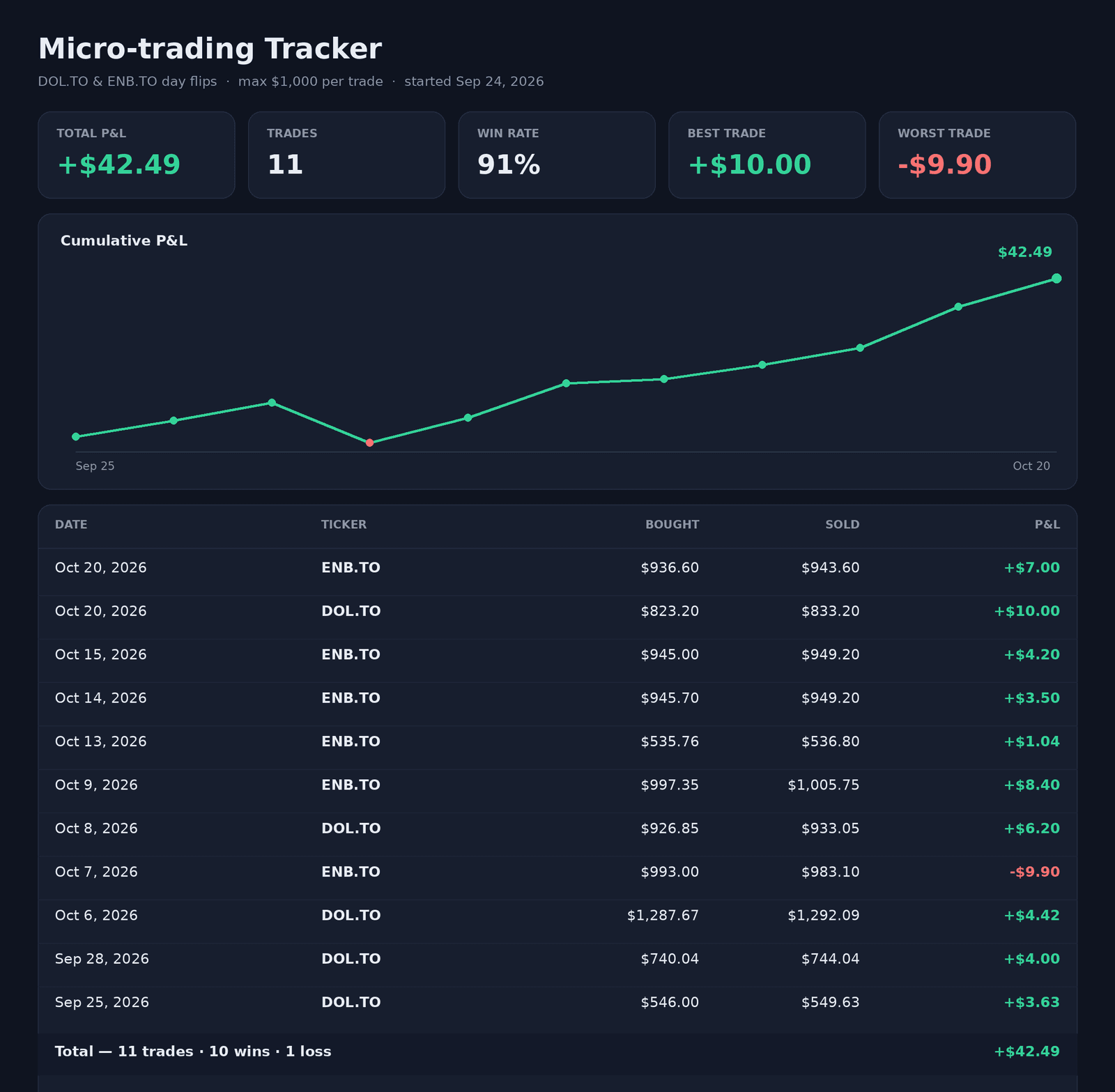
Talk is cheap. Numbers are not. So Muse built me a small tracker app where every trade gets logged — buy amount, sell amount, profit or loss, and notes.
Every row in that app is a real trade from my brokerage account. No cherry-picking, no hiding the red one. It's right there in the list.
The Results: All 11 Trades
| Date | Stock | Bought | Sold | Result |
|---|---|---|---|---|
| Sep 25 | DOL.TO | $546.00 | $549.63 | +$3.63 |
| Sep 28 | DOL.TO | $740.04 | $744.04 | +$4.00 |
| Sep 29 → Oct 6 (held overnight) | DOL.TO | $1,287.67 | $1,292.09 | +$4.42 |
| Oct 7 | ENB.TO | $993.00 | $983.10 | −$9.90 |
| Oct 8 | DOL.TO | $926.85 | $933.05 | +$6.20 |
| Oct 9 | ENB.TO | $997.35 | $1,005.75 | +$8.40 |
| Oct 13 | ENB.TO | $535.76 | $536.80 | +$1.04 |
| Oct 14 | ENB.TO | $945.70 | $949.20 | +$3.50 |
| Oct 15 | ENB.TO | $945.00 | $949.20 | +$4.20 |
| Oct 20 | DOL.TO | $823.20 | $833.20 | +$10.00 |
| Oct 20 | ENB.TO | $936.60 | $943.60 | +$7.00 |
| Total | +$42.49 |
Win rate: 10 out of 11 (91%). Best trade: +$10.00. Worst trade: −$9.90.
That works out to about $2 per trading day so far (roughly $1.50 per calendar day) — the first rung of the ladder, on the way to the $5–$10 a day goal.
The One Red Day (My Favourite Trade)
October 7. Enbridge. I bought 15 shares around $66.20, following the morning ticket. The stock faded all session. My stop level got tagged.
Old me might have held on and hoped. The rules said sell. So I sold: −$9.90.
Here is the note I logged that day, word for word:
"The $9 loss was already incurred — holding would have risked $10–20+ overnight to chase it."
That is the whole philosophy in one sentence. The stop didn't ruin my day; it protected the experiment. Small losses are the price of small wins. The system only breaks if you break the system.
The Margin Twist: No New Cash In
Now the part people ask about most: where did the trading money come from?
Margin. My brokerage lets me trade using its money, secured by my existing account. For this experiment, I never transferred in any new cash — not on day one, not ever.
Is borrowed trading money free? Of course not. The broker charges interest, and I saw it once, in the most honest line of this whole experiment: my third trade (the Dollarama position I held from September 29 to October 6) cost me $0.81 in margin interest — about 12 cents a day — already deducted in the +$4.42 result above. That early trade was also over $1,000 and held overnight, which is why the rules got stricter.
$0.81. That's the total cost so far of using someone else's money. But don't let the tiny number fool you:
Margin is a tool, not magic. If a stock gaps down hard, you owe the money back regardless. That's exactly why this experiment uses tiny positions, boring stocks, same-day exits, and a hard −1% stop. The rules aren't decoration — they're what makes the margin safe-er. Never safe. Just safer.
What I've Learned So Far
- A plan made at 6 AM beats a feeling at 11 AM. Every bad trading decision I've ever made happened mid-session, on emotion. The ticket removes the emotion.
- Small and repeatable beats big and lucky. +$3 here, +$4 there feels unimpressive — until you realize it compounds into a habit, and habits compound into income.
- The stop loss is the hero. My only red day is also my proudest trade.
- An AI is a great system-runner. Malli doesn't get greedy, doesn't get scared, and never forgets to ask me: "Did you log it?"
- Honest tracking changes everything. When every trade is written down — wins, losses, even the 81 cents of interest — you stop telling yourself stories and start seeing the truth.
The Honest Fine Print
This is a real experiment with real (tiny) numbers, and it could have gone the other way. Eleven trades is a small sample. Commissions may apply. Markets have bad months, and a −1% stop doesn't protect you from every surprise. This is not financial advice — it's one person's public experiment. If you try anything like this, use money rules you can survive being wrong with, and understand margin before you touch it.
What's Next
The experiment continues. The next milestone: a full week averaging $5 a day, then the push toward $10. Same two stocks. Same rules. Same 6 AM ticket.
The best part isn't the $42.49. It's that most mornings, investing takes me about 15 minutes — read the ticket, place the order, live my life, log the result. The system does the thinking; I just do the discipline.
Want to follow along? I'll keep posting the real numbers — green days, red days, and all 81 cents of interest.
Stay curious, stay disciplined, and remember: the real win is a system you can repeat, not a trade you got lucky on.
See you in the next update!
Have a business problem AI could solve? Let's talk.
Summary
For 4 weeks, Malli in the Muse app sent a 6 AM ticket each weekday. Two Canadian stocks on margin — no new cash in — and I'm up $42.49 across 11 trades.